You Won’t Believe These Hidden Cultural Gems in Cairo
Cairo isn’t just pyramids and bazaars—there’s a deeper soul hiding in plain sight. I wandered beyond the tourist trails and stumbled upon quiet courtyards, centuries-old performance halls, and forgotten art hubs where tradition breathes through every tile and tune. These secret cultural venues reveal a side of Egypt most travelers never see. If you’re craving authenticity over crowds, this is your gateway to the real Cairo. Away from the postcard panoramas and packed tour buses, the city unfolds in moments of stillness, sound, and sacred craftsmanship. This is not a city frozen in antiquity, but one where heritage lives in daily rhythm, passed through generations in hushed chants, intricate patterns, and the resonance of ancient melodies. For the thoughtful traveler, these spaces offer more than sightseeing—they offer connection.
Beyond the Pyramids: Discovering Cairo’s Cultural Soul
While millions flock to the Giza Plateau each year, captivated by the timeless silhouette of the Great Pyramid, a quieter and equally profound Cairo exists just beyond the dust and daylight of its most famous landmarks. This other Cairo is not found on souvenir maps or in guidebook checklists, but in the narrow alleyways of Islamic and Coptic districts, where history is not preserved behind glass, but lived in the daily rituals of worship, art, and music. The true cultural soul of the city pulses in venues that have stood for centuries—some nearly a millennium—where the scent of incense mingles with the sound of calligraphy pens on parchment and the low hum of devotional recitation.
Shifting focus from monumental sights to intimate cultural spaces transforms a visit from passive observation to meaningful immersion. Instead of merely photographing history, travelers can witness it in motion. These spaces—mosque courtyards, Coptic chapels, revived madrasas, and underground galleries—are not relics of the past, but living institutions where tradition is practiced, not performed. They are where Egyptian identity is nurtured, refined, and quietly sustained. For a visitor, especially one seeking depth over distraction, these venues offer a rare privilege: to stand in the presence of continuity, where the past is not reconstructed, but remembered and reenacted with reverence.
What makes these places so powerful is their authenticity. There are no timed entry tickets, no audio guides, and rarely any signage in English. Visitors are expected to move with quiet respect, to observe rather than dominate the space. This absence of commercialization is precisely what makes the experience so moving. In a world where heritage is often packaged for mass consumption, Cairo’s hidden cultural gems remain refreshingly uncurated—accessible to those who seek them with patience and humility.
The Hidden Mosque Courtyards: Where History Whispers
Behind unassuming stone archways in the heart of Islamic Cairo lie some of the city’s most breathtaking architectural treasures—mosque complexes that have stood for centuries as centers of learning, prayer, and spiritual reflection. Among them, the Sultan Hassan Mosque and Al-Rifa’i Mosque stand as twin pillars of Mamluk-era grandeur, yet they are often overlooked by tourists who rush past their massive gates en route to more famous landmarks. These are not merely places of worship; they are acoustic sanctuaries, where the echo of Qur’anic recitations lingers in vaulted halls, and where the geometric precision of tilework seems to invite contemplation.
The Sultan Hassan Mosque, completed in 1363, is a masterpiece of Islamic architecture. Its towering iwans—vaulted halls opening onto a central courtyard—are arranged around a tranquil fountain where worshippers once performed ablutions. The precision of its stone carving, the symmetry of its layout, and the sheer scale of its construction reflect a devotion not only to faith but to artistry. Though it is occasionally visited by tour groups, it is during the quieter hours—early morning or late afternoon—that the space reveals its true atmosphere. The light filters through stained glass, casting patterns on marble floors, while the soft murmur of prayer or the distant sound of a muezzin’s call adds to the sense of timeless serenity.
Adjacent to it, Al-Rifa’i Mosque, completed in the early 20th century, shares the same architectural language but serves as the final resting place for members of Egypt’s royal family, including the last Shah of Iran and King Farouk. Despite its proximity to the Citadel, it remains relatively uncrowded, offering a rare opportunity to experience a grand mosque without the press of tourists. Both sites occasionally host traditional Sufi gatherings, where rhythmic chanting and devotional music create a meditative atmosphere. Visitors are welcome during non-prayer hours, provided they dress modestly and move with quiet respect. These courtyards do not demand attention—they invite stillness.
Coptic Heritage in Old Cairo: A Living Legacy
Just south of the bustling modern districts lies Masr al-Qadima—Old Cairo—a neighborhood that holds some of Egypt’s most sacred Christian sites. Here, nestled among ancient walls and quiet lanes, stand churches that have survived for over 1,500 years, serving as enduring symbols of one of the world’s oldest Christian communities. The Hanging Church, so named because it was built atop the gatehouse of a former Roman fortress, is perhaps the most famous. Its wooden roof, shaped like the Ark of Noah, shelters a sanctuary where Coptic liturgical chants still rise through the stone arches every Sunday morning.
But the church is not a museum. It is a living place of worship, where families gather, candles flicker before icons, and priests in long robes move through centuries-old rituals. The air carries the scent of myrrh and beeswax, and the walls are lined with icons painted in the traditional Coptic style—bold colors, solemn eyes, and symbolic gestures that speak of faith beyond time. Adjacent to the church, the Church of St. Sergius is believed to be built on the site where the Holy Family rested during their flight into Egypt. Pilgrims and visitors alike descend into its underground chamber, a space so quiet it feels suspended outside of history.
Beyond the churches, Old Cairo is home to monastic libraries that preserve fragile Coptic manuscripts—handwritten texts in Coptic and Greek that date back to early Christian scholarship. Access is limited, but guided tours through institutions like the Coptic Museum offer a rare glimpse into this intellectual and spiritual heritage. These are not relics of a bygone era, but living threads in a continuous tradition. For visitors, the experience is not about spectacle, but about presence—about standing in a space where faith has been practiced without interruption for generations.
Al-Muizz Street: The Open-Air Cultural Spine
Running through the heart of Islamic Cairo, Al-Muizz li-Din Allah Street is one of the oldest and longest preserved medieval streets in the Islamic world. Once the ceremonial avenue of Fatimid caliphs, it has undergone decades of restoration to revive its former glory. Today, it stands as a living museum of Islamic architecture, lined with madrasas, caravanserais, and palaces that showcase the evolution of Cairo’s urban and cultural landscape over nearly a thousand years. But beyond its magnificent façades, Al-Muizz is also becoming a hub for intimate cultural programming that brings history to life in unexpected ways.
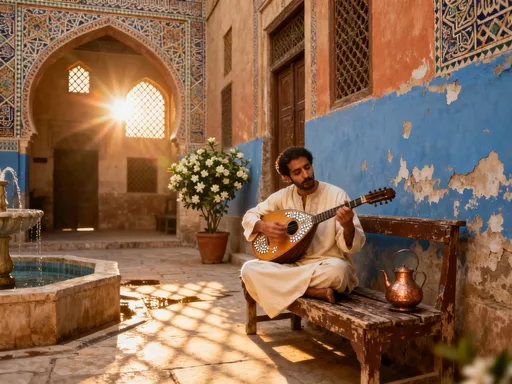
Restored buildings such as the Al-Ghuri Complex and the Beit El-Suhaymi now host small-scale events that connect past and present. Calligraphy workshops invite visitors to learn the art of Arabic script under the shade of centuries-old courtyards. Oud performances—featuring the pear-shaped lute central to classical Arabic music—fill the air with melancholic melodies during evening gatherings. During Ramadan, lantern-making sessions allow families to craft traditional fanous lanterns, continuing a festival custom that dates back to Fatimid times.
What makes Al-Muizz so special is its adaptive reuse. Rather than turning these historic structures into static exhibits, cultural organizations have found ways to reactivate them as spaces of learning and creativity. This approach ensures that the buildings remain relevant, not just preserved. For travelers, it means access to experiences that are both authentic and immersive—far removed from the commercialized souvenirs of Khan el-Khalili. Walking down Al-Muizz, one doesn’t just see history; one hears it, touches it, and even participates in it.
Underground Art Hubs and Indie Galleries
Beneath the surface of Cairo’s bustling downtown, a vibrant contemporary art scene thrives in unassuming spaces—galleries tucked into upper floors of 19th-century buildings, studios hidden behind iron gates, and cultural centers that operate with quiet determination. Among them, the Townhouse Gallery and Mashrabia Gallery stand out as pioneers of Egypt’s independent art movement. Founded in the 1980s, Townhouse began as an artist-run space in a converted townhouse in downtown Cairo and has since become a vital platform for emerging Egyptian artists exploring themes of identity, memory, and social change through painting, installation, and performance art.
These galleries are not commercial ventures in the traditional sense. They operate with a mission to foster dialogue, support artistic freedom, and create space for critical thinking in a society where public discourse can be constrained. Exhibitions often tackle complex subjects—urban transformation, gender roles, historical memory—but do so with subtlety and poetic resonance. What makes visiting these spaces so rewarding is the intimacy. There are no crowds, no audio guides, and rarely any barriers between viewer and artwork. Artists often attend openings, offering personal insights into their work, and guided tours provide context that deepens understanding.
Access is straightforward but requires a bit of initiative. Most galleries publish their exhibition schedules online, and entry fees are nominal—often just a few Egyptian pounds, with proceeds supporting the artists and maintenance of the space. The atmosphere is welcoming but serious, encouraging contemplation over casual browsing. For travelers interested in the pulse of modern Egyptian culture, these venues offer a rare window into the creative spirit of a new generation—one that honors tradition while boldly reimagining the future.
Traditional Music Houses: Where Sound Carries Centuries
In a city where music has shaped spiritual and social life for centuries, certain venues remain dedicated to preserving the rich heritage of classical Arabic music. These are not large concert halls with spotlights and amplifiers, but intimate spaces where the art of tarab—the emotional ecstasy induced by music—still holds sway. Weekly gatherings, often called tarab nights, take place in small recital halls within the Cairo Opera House complex or in private cultural centers in neighborhoods like Zamalek and Garden City. Here, musicians gather to perform in the maqam system, an intricate modal framework that allows for deep improvisation and emotional expression.
A typical evening begins with a solo oud player setting the mood, followed by a vocalist who weaves through complex melodic lines, supported by frame drums and qanun, a plucked zither with metallic strings. The audience listens in near silence, drawn into the unfolding emotion of the performance. These concerts are not entertainment in the modern sense—they are spiritual and aesthetic experiences, where music becomes a form of meditation. The repertoire often includes works by legendary composers like Sayed Darwish and Umm Kulthum, whose songs remain deeply embedded in the national consciousness.
For visitors, attending such a performance requires preparation. Tickets can be purchased in advance through the Cairo Opera House website or at the box office, and it is advisable to arrive early to secure good seating. Dress is semi-formal, and photography is usually permitted only before or after the performance. The most important rule, however, is silence—out of respect for the musicians and the tradition they uphold. To witness a tarab night is to understand that in Cairo, music is not background noise, but a living thread connecting past and present, heart and history.
How to Find and Visit These Venues Responsibly
Accessing Cairo’s hidden cultural gems requires more than curiosity—it demands respect, awareness, and a willingness to adapt to local norms. These spaces are not tourist attractions in the conventional sense; they are functional parts of the city’s spiritual, artistic, and intellectual life. As such, visitors must approach them with humility and mindfulness. The first step is timing. Religious sites like mosques and churches should be visited outside of prayer hours, typically in the late morning or early afternoon. Many cultural events, such as music performances or workshops, are announced through gallery websites, cultural center newsletters, or local event listings, so checking ahead is essential.
Dress code is another important consideration. Modest clothing—covering shoulders and knees—is expected in religious and conservative spaces. Women may be asked to cover their hair in certain mosques, and scarves are often provided at the entrance. In galleries and performance venues, dress is more relaxed but still respectful. Behavior matters just as much as appearance. Silence, especially in prayer halls and concert spaces, is not just polite—it is a form of participation. Avoid loud conversations, sudden movements, or intrusive photography. When in doubt, observe how locals behave and follow their lead.
Supporting preservation is also part of responsible visitation. Many of these venues rely on small entrance fees, donations, or volunteer efforts to remain open. Paying the suggested fee, purchasing a catalog, or attending a fundraising event contributes directly to their sustainability. Engaging with local guides who specialize in cultural tourism can also enrich the experience while supporting community-based initiatives. Above all, the goal should be to leave these spaces as undisturbed as they were found—honoring their purpose, their people, and their enduring significance.
Cairo’s true magic isn’t in its fame—it’s in its quiet corners where culture still pulses with purpose. By stepping into these hidden venues, travelers don’t just see history; they become temporary witnesses to its continuity. The city reveals itself not in grandeur, but in grace—one whispered prayer, one strummed oud note, one hand-painted tile at a time. These are not destinations to be checked off a list, but experiences to be absorbed with care. For the thoughtful traveler, especially one seeking depth, connection, and authenticity, Cairo offers not just sights, but soul. In its hidden cultural gems, the past is not behind us—it is all around us, alive, breathing, and waiting to be heard.